
Asserting that there was growing scourge of terrorism in view of fast growing linkages of terrorist groups across the globe, India on Tuesday strongly advocated stepped up cooperation through intelligence exchange and training with 54 African countries.
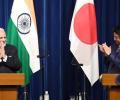
'Relations between India and Japan are robust and devoid of either shadow of history or any irritant.' 'In fact, there is plenty of warmth and goodwill earned over history. There are no negatives but only opportunities,' notes Dr Rajaram Panda.

'It will make good sense for military men on that side of the table to be confronted by our own.'

Modi held comprehensive talks with Singapore Prime Minister Lee Hsien Loong on ways to enhance cooperation in key sectors including trade and investment.

He said he has always maintained that instead of fighting with each other, India and Pakistan should together fight against poverty.

"It would be my hope that people understand why this particular transaction is important for us," the EAM said in Washington, DC.

India is no longer shying away from playing a role on the regional and international stages and is willing to don a bigger role in regional politics. It is showing traits of a responsible stakeholder in the regional security dynamics, says Dr Rahul Mishra.

Kuala Lumpur's delay in roping in India to help track the missing aircraft is an indicator that New Delhi must redouble its diplomacy and capacity demonstration in East Asia, feels Nitin Pai

Modi's arrival has changed the optics of the visit. There is a different demonstration of the confidence level in the Indian leadership, but not much has changed beyond that, reports Sheela Bhatt/Rediff.com.

'This is the first time that the Americans have agreed to refer to "cross-border terrorist attacks" in a joint statement.' 'No wonder Pakistan has called the joint statement "singularly unhelpful" and has blasted it, and its all-weather friend China has applauded Pakistan's frontline role in combating terrorism,' points out former foreign secretary Ambassador Kanwal Sibal.

India and Iran on Monday decided to jointly combat terror, radicalism and cyber crime as the two strategic partners signed 12 agreements including a "milestone" pact on developing the key Chabahar port for which India will provide $500 million.

United States President Barack Obama is impressed with Prime Minister Narendra Modi's vision of the big things he wants India to achieve.

'Even if such a thing happens, it will not prolong for many days like Doklam did.' 'That is because both the leaders do not want it.'

Chinese President Xi Jinping has announced that the 2.3 million strong People's Liberation Army, the world's largest, will be trimmed by three lakh.

India and China on Wednesday signed in all nine agreements, including the Border Defence Cooperation Agreement and one on strengthening cooperation on trans-border rivers, after restricted and delegation-level talks that lasted over two hours as Prime Minister Manmohan Singh and Premier Li Keqiang met for the second time this year for talks which the Indian leader described as "fruitful and productive".

'India alone cannot walk the path of peace. It also has to be Pakistan's journey to make,' says Prime Minister Narendra Modi at the government's geo-political flagship initiative "Raisina Dialogue-II".

Rajaram Panda explains why the US president needs to restrain himself and build a relationship with China to put any credible pressure on North Korea.

'The accusation that Pakistan risks losing sovereignty to China is emotive and has the potential to spread.' 'China will, however, remain intent on achieving its strategic ambitions of acquiring Gwadar port and securing a large chunk of Pakistan occupied Kashmir,' says former RA&W officer Jayadeva Ranade.

More than 2,000 activists of various religious and jihadi outfits in Pakistan on Wednesday protested against the visit of Home Minister Rajnath Singh, accusing him for the unrest in Kashmir.
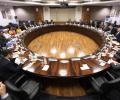
'India appears to have stood its ground on strategic autonomy by resisting US pressure on Russia, China and Iran, but succumbed to the temptation to walk into a tighter embrace in defence cooperation, a high priority of the Trump administration,' notes Ambassador T P Sreenivasan.

The two PMs called upon all countries to work towards rooting out terrorist safe havens and infrastructure.

In the case of India, there are no specific references in China's white paper. However, there are several takeaways for India, says Srikanth Kondapalli.

'Here in Delhi, the Modi government is supposedly looking at 'options' to hit back at Pakistan in any whichever way it can, while in Washington, the Obama administration is looking for ways to strengthen US military cooperation with Pakistan,' says Ambassador M K Bhadrakumar.

As India rises, creating niche areas for itself in the Asian landscape, China and India are bound to step on each other's vital areas of importance, says Srikanth Kondapalli.

India and Japan have a shared interest in countervailing China's hegemonic ambitions in Asia. Although neither has an interest in forming an overt anti-China alliance, Tokyo and New Delhi feel increasingly obligated to work together to find ways to guard against a muscular Beijing's power sliding into arrogance, says Brahma Chellaney.

After Pyongyang tests a missile potentially capable of reaching the US, Dr Rajaram Panda explores the realistic -- and peaceful -- options before Donald Trump and the international community at large.

Four major political takeaways from Narendra Modi's much-anticipated trip to China

Swaraj said there is scope to do a lot more and this would be an important element of their deliberations.

'Chinese leaders rarely receive their foreign guests in cities other than Beijing. Such respect for India!' 'Does it mean that Modi could replicate "the warmth and unconventional way" by sending Indian troops into Tibet, as Xi did in Chumur (Ladakh) when he arrived in India? Of course, Indians are far too polite to do so,' says Claude Arpi.

The Chinese leader will display his grip on the Communist party and chart his plans for his country's future.

'While visits and personal meetings are useful, changes of strategic significance have occurred recently, with Beijing trying to take the lead which Modi must take note of.'
.jpg)
Modi government must push reforms at a fast pace to restore growth.

China's intended role for AIIB is not so different from the existing Western lenders like the World Bank.

Prime Minister Narendra Modi enjoys a close relationship with Shinzo Abe. For Abe, "a strong India is in the best interest of Japan, and a strong Japan is in the best interest of India."

'As in the Panchatantra tale of the cat and the monkeys, it is possible for the clever swing State to play off the two competing powers.'

Outlining seven principles of engagement for closer cooperation between India and China, Prime Minister Manmohan Singh on Thursday said the two countries should show sensitivity to each other's interests and sovereignty and move quickly to resolve the boundary issue.

'We rarely choose to fight when the threat is still a nascent threat. When we do fight, we fight when the invaders reach Panipat and are preparing to knock on the gates of Delhi.'

'Building on the potential for closer ties is the changing narrative in each country about the other. The Chinese narrative on India has become significantly more positive over the past few years,' says Walter Andersen and Zhong Zhenming.

'Assuming the official defence allocations represent the true picture, the $142 billion figure still represents a phenomenal increase and surpasses that of Japan ($42 billion), India ($40 billion), South Korea ($33 billion) and several other Asian countries put together and shows that China is flexing its military muscle.'

PM Modi addressed the Sri Lanka Parliament on Friday.
